Tuesday, 5 April 2011

Dirty little robin

After a drizzly night it was a surprise to awake to a promising morning.  Autumn was certainly in the air, but light fluffy clouds clung to the sides of the mountains, and sunshine poked through in places.  More fresh snow was evident, but as we headed to the pie shop we knew it was going to be a great day!  Miles Better Pies in Te Anau really is a great spot to grab some lunch, and with the axles of the Hyundai groaning under the weight of apple pies, we headed back up towards the Homer Tunnel.

It was a gorgeous morning, the cloud, the cool crisp air, and the hope that we may see some more new birds.  A group of bulls were being moved along the road, and with Lily having successfully photographed almost every magnificent animal as we navigated through the ‘flock’ we continued on.  Passing the spot we had seen the falcons yesterday we scanned the countryside, but no luck.

Heading on to Knob’s Flat we again stopped briefly and had bellbirds, rifleman, tomtit and grey warbler right there in the carpark.  A very friendly male robin that was banded even took time out of his busy schedule to perch on my camera, and feeling that wasn’t enough even left his little calling card...guess at least he wasn’t an emu!  Interesting to watch the bellbirds and tomtits feeding on the Coprosma fruits.

Further along we made another stop on the edge of some beautiful forest and had brown creeper, fantail, tomtit, and bellbird, and great views of yellow-crowned parakeet.  It seemed that the forests were even more birdy than when I was last here in November.  We then did the beautiful walk at Cascade Creek, which is like walking through some elfin dream with thick mosses on every tree and stump, lichens, ferns, etc.  Again it was very birdy with rifleman and tomtits everywhere, and lots of yellow-crowned parakeets, and at one stage a bird feeding less than 2m away!  The sunlight filtering through the canopy and warming us as we stood on the shore of Lake Gunn was a nice touch.

Carrying on we then checked almost every section of the Upper Hollyford River for blue duck...not a sausage...not even a duck sausage!  We made a lot of stops and scanned a lot of the river, but the spots I have seen them before were empty, as were every other place we looked at...sometimes you just can’t win!  Nevermind, it was a gorgeous day to be out and the scenery was magnificent with the fresh snow dusting the tops catching the sun.

We checked the Homer Tunnel carpark for any errant kea, but there were none (they must have been reformed), and then headed back down into town.  A fairly uneventful trip, until passing our falcon spot, when Jean thought she spied something...it turned out not to be a falcon, but from that spot I found an adult male, possibly the same bird as yesterday, in the top of a beech tree.  Again scope views of a fantastic little bird, making this the third day in a row we have seen NZ falcon...not too shabby!

We headed on into Te Anau, had a rest before dinner again at the Fat Duck Cafe...another feast!

The dirty little robin...

Looking up from the Eglinton

Looking up from the Eglinton

The beautiful Eglinton Valley


Bird of the day – Rifleman x1, tomtit x1, SI robin x1 (specifically the little guy that pooped on my camera!)
Day total – Seen = 24 + 2H(kaka, dunnock); new for the trip = 3; total for the trip to date = 53

Monday, 4 April 2011

Fruiting madness and a double falcon day

So up and off south, with the aim of heading through to Te Anau, seeing what the weather was like and maybe making a run for rock wren if it looked ok.  Leaving a drizzly Omarama things we headed through making a quick stop to check out a local riverbed, before then passing though the stunning Lindis Pass.  Weather was picking up all the time, and with golden tussocks and gob-smacking scenery it was all looking promising.  We made a few brief stops along the way for coffee, fuel and scenery, before taking lunch at the just before Te Anau.

The weather had certainly improved, so I decided it was better to head into the Eglinton and try for the often very weather dependent rock wren whilst it held off from the wetting stuff.  We had hardly entered the Eglinton Valley before a shape on a dead beech tree beside the road caught my eye, and almost pulling a perfect hand-brake turn pulled back alongside a stonking female falcon.  She flew down across the road in front of us, and disappeared into the long grass, before appearing again and flying to a small bush.  Whatever she had gone for she was unsuccessful, but we pulled along parallel with her, and through the scope had really nice views of what must have been another bird of the year.  She was dive-bombed by a small male falcon, who then disappeared off down the valley, but sure gave a great display of the size dimorphism these birds have.

She then did another couple of short flights, before flying across to the other side of the valley, landing in the top of a beech tree.  Not bad, three falcons in the first two days of a tour!

So we headed onwards, making a couple of other quick stops.  One included some superb views of male and female tomtit, black fantail, and grey warbler, and some of the most heavily laden Coprosma bushes I have ever seen.  It seems to be a really good year for fruiting plants!

At Homer tunnel there were no kea in the carpark (secretly pleased based on the hire care insurance excess!), and we headed up the loop track.  After a full circuit and no sight nor sound it was time to settle in.  Part way along the trail I heard the characteristic call a little way off, and after perhaps 8 minutes or so a rock wren finally showed itself.  We had great views of two birds, one a banded bird part of an Otago University study.  In the end both flew right past us, so very happy campers, and we even had a flying kea.  Checking the Hollyford on the way out, no sign of any blue duck, but we will give it a good bash tomorrow as well.
Awesome dinner as per usual at the Fat Duck in Te Anau...


Autumn colours in the Kawerau Valley

Sweet briar 'hip'

Sweet briar 'hip' with rain drops

Mmmmmm....wine!

Mmmmm....hic....hic....

Bog pine in fruit

Coprosma fruiting madness

Coprosma fruiting madness

Stars of the day...rock wren

Stars of the day...rock wren


Bird of the day – Rock wren x2, SI tomtit (female) x1
Day total – Seen = 24 + 2H(kaka, dunnock); new for the trip = 3; total for the trip to date = 53

Sunday, 3 April 2011

Falcon and black stilt on day one of a tour??!!

Well the last week has been a hectic one!  I continued with some of my contract bird survey and report writing work on Monday and Tuesday, visiting some stunning spots in Central Hawkes Bay.  Wednesday through to Saturday morning was spent packing up the house, moving across the road into Mum and Dad’s place which we are renting from them (thanks Mum and Dad!), and packing the rest of our stuff into a shipping container for storage.  My own extremely optimistic target of having everything moved by Friday was never going to eventuate, despite a fair bit of pre-packing by Adel and having Mum and Dad to help!  So we finally finished packing the last of it Saturday late morning, had some meetings midday, and then I flew to Christchurch late afternoon to start a tour the next day....phew!  Will have to remember to never agree to start a tour the day after moving house again!

Anyway, the flights to Christchurch were a good chance to catch up on some sleep, and then spent the evening catching up with Aaron and Sarah in Christchurch.  Thanks for a lovely dinner guys!  I must say despite seeing the footage on TV and knowing what had been happening in the city since the big quake in February, I was still shocked to see Army/Police barricades around the central city, and the degree of damage to house, walls, buildings and roads.

Although the forecast was not looking promising, we left Christchurch this morning with positive thoughts, and someone must have lived a privileged life, as the weather held all day, and was actually quite warm in parts.  We headed south through to Ashburton, and then inland towards Omarama.  Our main targets were the special birds of the Mackenzie Basin, with black stilt of course being the key species.  The Mackenzie Basin has amazing scenery any time of the year, but with the autumn colours coming through it was even more beautiful.  This was to be Day One of a seven day Wrybill Birding Tours, NZ tour around the bottom of the South and Stewart Islands.

We made a couple of quick stops along the way, before grabbing some lunch in Lake Tekapo, and then heading up Mount John armed with enough paper napkins to mop up even the most monumental of food spills!  Despite a cool breeze and predominantly cloudy conditions, the views were stunning.  As we slowly made our way up the road towards the top, scanning for chukar, a bird perched on a rocky outcrop only 50m or so away caught my eye, and at the same time Lily said ‘What’s that over there?’...the answer came pretty quickly...it was a NZ falcon!  Not a bad start to the tour, with a beautiful juvenile female falcon there right in front of us.  We got great views of it perched in the stiff breeze for several minutes, before it took flight and headed out in front of us, giving lovely flight views as well...what more could you ask for, except perhaps a great shearwater (read here)!!!

Heading up the road a little further, within literally 100m we had a small covey of around 8 chukor within 30m of the road.  There were several juveniles still not quite fully feather amongst them, and they feed on the tussock and grass seeds, completely at ease with us despite the close proximity.  They really are stunning birds up close, and especially so with sun peeping through the clouds, with the colours of the tussocks and grasses against their grey and fawn feathers.  Having had great views, we headed to the top, parked in the carpark and admired the views, and then slowly made our way back down, parking with the spectacular Lake Tekapo in front of us as a backdrop for lunch.

After lunch we headed through to Glentanner, with the target bird keenly in our sights.  We had hardly edged through the gate before I had one in the bins, and driving to the edge of the lake we had a pair within 60m.  Several other adults could be seen further around, and after spending around an hour at the site, we had a minimum count of nine birds...probably around 10% of the wild population!  Statistics like this make you a little uneasy!  The initial pair we had seen obviously felt that 60m was a little bit far for us to be admiring them from, and at one stage they moved to within about 20m of us, feeding casually in small pools and lakeside muddy margins – awesome!

We spotted a few more new birds – banded dotterel, NZ scaup, Pacific black duck,etc. and then headed back, and onwards to Lake Benmore.  We made a brief stop at Lake Poaka, seeing huge numbers of Canada geese and another black stilt, and then down to the Lake Benmore where we had lovely views of crested grebe and tried (unsuccessfully) for Baillon’s crake.  We had to miss something I guess!

We arrived into Omarama and checked into the great Ahuriri Motels (Rose and Tom really look after us), before a nice dinner and couple of wines at the Wrinkly Rams.  All in all a very nice first day with some stunning birds!

Merino sheep in tussocks in the Mackenzie Basin

One of the nine black stilt seen at Glentanner

Sweet briar 'hips'

Toetoe along the Ohau channel

Toetoe along the Ohau channel

Toetoe along the Ohau channel

Reflecting on toetoe along the Ohau channel


Bird of the day – black stilt x2, white-faced heron x1

Day total – Seen = 38 + 1H (pipit); new for the trip = 39; total for the trip to date = 39

Sunday, 20 March 2011

Three Kings trip report and photos

Sav has written a full trip report for this trip, which we did 2-5 March 2011, and this trip surely has to be one of the best New Zealand pelagic birding trips we have ever done.  The four mega-rarities (Collared petrel - first NZ record, Tahiti petrel, sooty tern and wedge-tailed shearwater) were awesome enough, let alone the rest of the almost 90 reportable rarities seen during the four day trip!

I have just added a few photos to the thread on BirdingNZ.net here, and 63 images in an album on my Eco-Vista: Photography & Research facebook page.  Below I have pasted the full trip report by Sav and a few of the better images from the trip.  We are going to run this trip again for the sixth consecutive year, in early March 2012 and only have three places left.  So if you are interested then let us know as soon as possible.  This is a cost-share, but we organise it through our bird guiding business Wrybill Birding Tours, NZ.

Three Kings pelagic 2 – 5 March 2011
Participants: Brent Stephenson, Steve Wood, Matt Jones, Detlef Davies, Ian Smith, Igor Debski, Sav Saville (report compiler) and Tank Barker (Skipper). Aboard the good ship “Demelza”.

2 March.Left Houhoura at 0715 with fair weather and a light northerly breeze. Once clear of the Houhoura Heads set off NE towards warm water, aiming to be at North Cape that evening. Running towards our first chum-stop we were followed by several Flesh-footed Shearwaters and Black Petrels, as we were to be for virtually all of the next 4 days. A few Fluttering Shearwaters were present inshore early in the morning but it wasn’t long before we had a taste of things to come with our first WHITE-NAPED PETREL before 0900, quickly followed by 3 NEW ZEALAND STORM-PETRELS and a group of 3 LONG-TAILED SKUAS. Another NZ STORM-PETREL and another 2 LONG-TAILED SKUAS were encountered in the hour before the stop, with a few Black-winged and Cook’s Petrels.
We stopped to chum for 1.5 hrs on a deep water shelf and soon had our first mega-rarity when a WEDGE-TAILED SHEARWATER was spotted among the throng of Flesh-footed Shearwaters and Black Petrels. The bird was surprisingly easy to lose among it’s more common relatives and we wondered just how many more go unfound (?). Another 3 WHITE-NAPED PETRELS were attracted to the boat, along with a few Cook’s and Black-winged Petrels, White-faced Storm-petrels and 4 NZ Albatross.
About 1300hrs we set off towards North Cape, and continued to find good birds at regular intervals – yet another LONG-TAILED SKUA, another WHITE-NAPED PETREL and 2 KERMADEC PETRELS (both intermediate phase birds). By the time we anchored at North Cape we had amassed a total of 15 reportable rarities – what a good day! (but only a taster for the days to come……)

3 March.Another bright day with light northerlies. Steaming towards the Three Kings throughout the morning brought more and more interesting birds into view – all the commoner species were in good numbers – Black-winged Petrel was just about the most numerous, but it was the number and quality of the rare birds that was staggering. A couple of GREY TERNLETS flew past, but who would have thought we would see 4 WHITE TERNS!!??, or another 3 LONG-TAILED SKUAS, 3 more WHITE-NAPED TERNS, another KERMADEC PETREL, a WILSON’S STORM-PETREL……and then it all got a bit silly. I spotted a Pterodroma passing which had a dark head, and thinking it was probably a GOULD’S PETREL I raced up to the bow where most of the others were. The bird continued on past without stopping and was quickly lost before anyone could get a really good look, but at that moment I saw something else and although it was new to me I knew instantly that we had a TAHITI PETREL. A first for Three Kings pelagics and maybe the first live record for NZ waters. Some rather average photos prove the identity without doubt.
A chumming session at this point brought another brief view of presumably the same individual, plus 4 WHITE-NAPED PETRELS, a KERMADEC PETREL and all the usual suspects. From 1400 till 1800 we steadily made our way up to The Kings sort of uneventfully, but with almost constant sightings of Black-winged Petrel and lots more WHITE-NAPED PETRELS (at least 20 in the day).

4 March.
Same weather as the last 2 days. We were beginning to get used to all the amazing birds : the first couple of WHITE-NAPED PETRELS barely raised a shout, a Pomarine Skua was new and another KERMADEC PETREL got the cameras going. Then a Pterodroma came past that was just so different to anything else I had seen. I shouted to Brent and Steve to photograph it and the results were more than a little surprising – it appears to be a COLLARED PETREL (a potential first for NZ) but we need to do a little more research to properly nail it down. Soon afterwards another strange looking Pterodroma pitched up. I didn’t see it very well, Brent swears it had a lot of black in the underwing, but the only photos show the top surface and it looks exactly like a STEJNEGER’S PETREL in that view (more to come on that later….). Oh, and another WHITE TERN, 4 WHITE-NAPED PETRELS and 3 LONG-TAILED SKUAS were around at the same time!
More chum before lunch brought lots of Grey-faced Petrels (17 at one time), more WHITE-NAPED PETRELS, another WHITE TERN, LONG-TAILED SKUA and a further sighting of WEDGE-TAILED SHEARWATER. A couple of Bryde’s Whales and a fair sized Mako Shark were diverting, and then a bird that I had long fancied to occur on one of these trips appeared - a beautiful adult SOOTY TERN.
The afternoon journey back to North Cape was punctuated by even more good stuff : at least 12 WHITE-NAPED PETRELS, 5 LONG-TAILED SKUAS, 3 GREY TERNLETS , 2 KERMADEC PETRELS and an amazing loose group of 6 WHITE TERNS!!!!! The Reef Heron that ambled past as we anchored was almost ignored.

5 March.All that good weather had to come to an end, and so it did at about midday. Cloudy skies to start with led on to torrential rain. So did we see any decent birds before the rain? Well, YES! About a dozen WHITE-NAPED PETRELS (making a rough total of 60 for the trip), 4 LONG-TAILED SKUAS (total 22), KERMADEC PETREL (#9), another WHITE TERN (#13), 2 more GREY TERNLETS, another WEDGE-TAILED SHEARWATER (and there must have been more that we missed) and then the final mega – a stonking GOULD’S PETREL came and flitted about over the chum slick for a minute or 2 allowing some very good photos.
So, including the 60 odd WHITE-NAPED PETRELS, we had about 90 reportable rarities in 4 days. What a trip.
We will almost certainly run another at the same time next year. Book early if you are interested!!

Species List.
Number of sightings with max at any one time in brackets.
Little Penguin 3 (2)
White-capped Albatross c25 (4)
NZ (Wandering) Albatross c20 (4)
Buller’s Albatross 4 (2)
Buller’s Shearwater many (15)
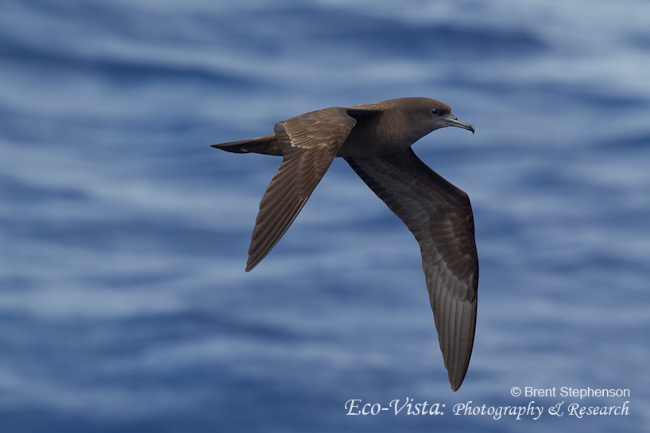
Wedge-tailed Shearwater 3 (1)
Sooty Shearwater 4 (2)
Flesh-footed Shearwater many (30)
Fluttering Shearwater many (100)
Little Shearwater 7 (3)
Common Diving Petrel 2 (1)
White-chinned petrel 2 (1)
Black Petrel many (30)
Cook’s Petrel c50 (2)
Gould’s Petrel 1 (1) and a couple of possible
Stejneger’s Petrel ?
Collared Petrel 1 maybe 2 (1)
White-naped Petrel c60 (3)
Black-winged Petrel c60 (2)
Grey-faced Petrel c150 (17)
Kermadec Petrel 9 (2)
Tahiti Petrel 1 (1)
Wilson’s Storm-petrel 1 (1)
New Zealand Storm-petrel 4 (3)
White-faced Storm-petrel c100 (30)
Grey Ternlet 7 (3)
White Tern 13 (6)
Sooty Tern 1 (1)
Long-tailed Skua 22 (3)
Arctic Skua 5 (1)
Pomarine Skua 1 (1)


One of the many white-naped petrels

New Zealand (wandering) albatross

Grey-faced petrel

Wedge-tailed shearwater

Wedge-tailed shearwater

Wedge-tailed shearwater

White-naped petrel

White-naped petrel

Grey-faced petrel

Kermadec petrel

The big blue marlin that got away - 200-300kg!

Tahiti petrel

White-capped albatross

Black-winged petrel

Black-winged petrel

Short-beaked common dolphin

Buller's albatross

Kermadec petrel

Flesh-footed shearwater

New Zealand (wandering) albatross

Collared petrel - first NZ record!

Bryde's whale - note fresh cookie-cutter shark scars

Sooty tern

Possible Gould's petrel

Possible American golden plover

Yesterday Sav came through to Hawkes Bay and spent a bit of time birding.  I had a family thing on so, when we met up back at my place he told me he'd found a possible American golden plover (AGP) at Ahuriri Estuary.  He stayed the night to catch up and work on plans for Wrybill Birding Tours, NZ with upcoming seasons tours, etc., and then today we headed across to look for the bird.

It was in the same spot as the Pacific golden plover (PGP) normally are, on the muddy area exposed by the tide on Meeanee Quay (opposite the Albatross Motel).  We checked it out through the scope first, and then I tried to get some photos.  Middle of the day the heat haze was terrible, and with the 800mm it really seems to enhance the distortion of heat haze.  The birds were pretty flighty, it was there with 16 Pacific golden plover, the long-staying grey-tailed tattler, and a bar-tailed godwit, and they never allowed me to get that close.  However, I got a few record shots, including photos of the bird in flight.  Will have to see what others make of it, but it looks pretty good for an American golden plover to us.

The white supercilium is just so strikingly white, giving the bird a really capped appearance, and the almost total lack of any gold in the plumage (except for a thin strip appearing on the back - strangely similar to Tim Barnard's bird at Maketu - see here) with an overall very grey appearance look good.  As does the very pointed attenuated body shape of the bird, with the wings projecting well past the tail.

I've posted photos below, and will hopefully get some better ones with less distortion in the next few days.

Possible AGP on the left (grey-tailed tattler in foreground on right, with PGP behind)


Possible AGP on right, PGP moulting into breeding plumage on left