Saturday, 19 March 2011

Big moon - Super Moon!

Just took this shot...beaut big ol' moon.

Apparently bigger than normal...the 19 March 2011 'Supermoon'
The full moon on 19 March 2011 is apparently the biggest and brightest in 18 years.  It is supposed to be 20% brighter and 15% bigger than normal, due to the fact it is the closest to the Earth it has been in 18 years.  This is due to variation in the egg-shaped orbit of the moon, meaning that the moon is not at a constant distance from the Earth.  It certainly did appear big and bright, but I would be able to tell you by how much!  More info can be found on the National Geographic news site.

Took this photo with my 1D MkIV with my Canon 800mm and 1.4x, mounted on a tripod in the backyard.  Probably looks a little different to what people are seeing in the Northern Hemisphere.

Oil of Oliva

A little ironic that yesterday I was with a team from the Hawkes Bay Regional Council doing a practice 'Oil Spill Exercise' at Mahia Peninsula, whilst the MV Oliva (a greek owned bulk carrier) was running ashore on Nightingale Island, in the Tristan da Cunha group.  This small group of extremely isolated Islands is in the South Atlantic, and is not only famous for wildlife, but also for being the most isolated island group on the plant.  In 1961 the entire island main island (called Tristan da Cunha) was evacuated when a volcanic eruption right beside the main town occurred, with people being transferred to the UK. Most of the people returned in 1963, and since then have made a living from lobster fishing, farming, and sale of stamps.  It has become an infrequent destination for cruise ships, due to it being so isolated, and ships finishing in the Antarctic often call past there on their way across to Cape Town and then up the west coast of Africa.

In 2009 I worked onboard the MV Minerva and we called in there for a day.  The weather was blue sky gorgeous, but there was a serious swell and we didn't manage to get passengers ashore on Tristan.  We did take supplied (potatoes, baked beans (!?), and other bits and pieces onboard though, so I did manage to set foot ashore.

The MV Oliva is said to have a cargo of Soya beans onboard, but of more concern is the 1500 tonnes of heavy fuel oil.  She has apparently broken her back in the relentless swell and fuel oil has leaked out and spreading around the coast of Nightingale.  This is of major concern for the Northern rockhopper penguins which are currently ashore, many probably moulting at this time of year.  There are also massive populations of other seabirds including Atlantic yellow-nosed albatross (c.1000 pairs, the species is endemic to the Tristan group), sooty albatross (c.200 pairs).  Lets hope rats have not been able to get ashore from the ship, as this would also have a serious impact on the islands biodiversity.

Latest news can be found here.

Nightingale Island (large island on the right) with Middle Island to the left, and Sotltenhoff Island to the far left.

Spinners Point where the ship MV Oliva has run aground

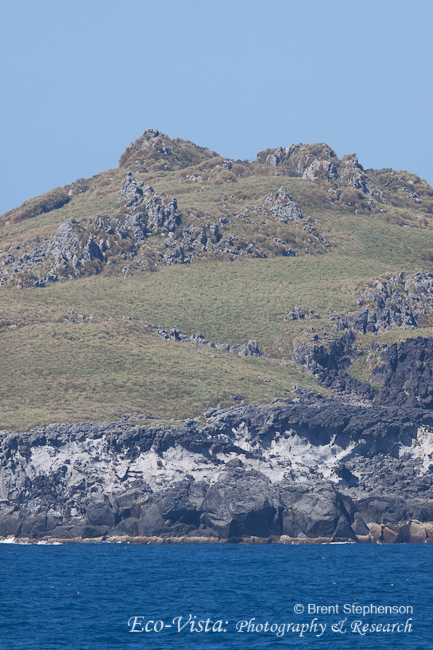
The habitat on Nightingale

Main Island of Tristan da Cunha
Atlantic yellow-nosed albatross in flight

Atlantic yellow-nosed albatross in flight at sunset
Atlantic yellow-nosed albatross taking off from the water

Atlantic yellow-nosed albatross low over the water at sunset

Thursday, 17 March 2011

Another album

Trying desperately to catch up on things, as well as get some 'real' work done.  I have just uploaded 140 images from the month I spent on the M/V Oceanic Discoverer working for Lindblad Expeditions during February.  The two cruises were Auckland to Milford Sound, and then back.  I did post blogs every few days, so these can be individually read in the archives on this site, but for those that just want to look at the pics, then go to my Eco-Vista: Photography and Research Ltd facebook page.

One of my favourite shots from the trip - flying fish in action

Monday, 14 March 2011

Old birds!

Well all this talk of 'Wisdom', the female Laysan albatross being the oldest wild bird on record really started to get a little annoying!  Being from a little rock in the South Pacific, we seem to often fall off the face of the earth when other Nations make comparisons of oldest, biggest, longest, blah, blah...  So when (largely US) sites started crowing on about 'Wisdom' being the oldest recorded wild bird, and quite possibly what may be the oldest 'currently living' wild bird, I thought the World had gone mad and suddenly forgotten our very own NZ icon - 'Grandma'.  Generally touted as being the oldest known albatross, she was first banded in 1937 at Taiaroa Head in Dunedin.  She apparently bred through most of her life, to finally raise her last chick in 1989, not returning the next season.  Therefore, with the average age of first breeding of Royal albatross suggested to be just under 10 years of age, and the fact she was banded breeding in 1937, she was at least 61-62 years of age...or was she?

Getting a little hot under the collar about all this, I decided to investigate this a little further myself, to try and get to the bottom of 'Grandma's' actual age...just so I could set the record straight.  What has ensued has been the destruction of the basis to many of my seabird talks onboard ships, and the utter dismay that I may have lied - and been lied to - for many years!

I contacted a colleague of mine, who shall remain nameless to protect his identity.  I emailed him to see if he could shed any light on the matter.  An email arrived with what can only be described as enough information to seriously question the authenticity of 'Grandma's' record.  I'm probably opening a whole can of worms here, and may incur the wrath of God, but heck, it's not the first time and wont be the last!

A paper produced in 1993 outlines longevity of Northern Royal albatrosses at Taiaroa Head, and specifically discusses the case of 'Grandma', being one of the founding birds.  This paper can be downloaded from the CSIRO website here.  She was banded with a single colour band by Lance Richdale, a pioneering seabird biologist, and apparently very accurate and methodical worker, on about 22 Dec 1937 when she was attending a nest with an egg.  The following year she was again breeding with the same male, at the same nest, and had her first metal band and another colour band added.  The pair were variously rebanded as metal bands wore out (they were using aluminium and copper in the early days), and with various colour bands.  In 1955 her mate failed to turn up, and she was present in the early part of the season, but not seen again until November 1963.  Sounds fair?  Not really in my mind.

An explanation for her supposed absence is that it was "probably related to the small amount of time" the ranger at the time was spending at the colony due to other duties.  In support of this is the fact that several other birds (three) had similar gaps during the same period (1955-68), with the longest gap being 12 years.  These four birds are the only ones on record to have been subsequently seen after being 'absent' for more than two years.  However, this makes little sense to me, and questions whether the same birds were actually subsequently sighted.

Whatsmore, in 1963 'Grandma' turned up without a metal band (sure this could have fallen off, maybe), but with two blue colour bands.  This is despite her last actual 'recorded' colour combination being Blue/Yellow on the left leg in Jan 1952.  Apparently, these colour combinations often consisted of multiple bands of the same colour, with bands of different materials being tested.  It was also suggested that the only birds with blue colour bands in combination with a metal band were 'Grandma' and her mate...  But if records were loose enough that exact combinations and multiple bands of the same colour were being used but not adequately recorded, then is it not possible other birds were banded with blue bands?  All sounds a little tenuous to me...  That the longest lived albatross at 62+ years was one of the first ever banded at Taiaroa Head, and actual records don't definitively prove it was the same female seems all to good to be true?  Especially when around 36,000 Southern Royal albatross have been banded on Campbell Island since the 1940s and apparently there haven't been any banding records over the age of 50 (yet).  A very trusting person might believe all this, but I just don't think I can.  Withstanding all this, even if it was the same bird, the average age of first breeding at the time might have been just under 10 years, but some females were first recorded breeding at 8 years (and in the 1970s as early as 7 years!).  So this could have made 'Grandma' a mere 59-60 years!

So, go on 'Wisdom' take the crown...but you still won't be a Royal!

This bird might not be 'Grandma' but it's a beaut Southern Royal albatross for sure!

Tuesday, 8 March 2011

"In Celebration of Hihi" (Stitchbird) Week - Tiritiri Matangi Island

While Sav is still compiling the trip report from the Three Kings pelagic, and I sort through the photos etc., I thought I would quickly post a few photos from my week on Tiritiri Matangi Island last September (2010).  I have loaded an album onto my Eco-Vista: Photography & Research (www.eco-vista.com) Facebook page with 125 of my favourite images I took during the week.  I was out there with my good mates John Ewen and Kevin Parker, partly in anticipation of the "In Celebration of Hihi" (Stitchbird) Week which starts in just a few days.  This is a week long exhibition of art work, with several of my images taken during this trip being displayed and for sale.  More information can be found on the Tiri Supporters website and if you haven't yet planned anything for this coming weekend and live near Auckland it could be a good thing to do.

The trip out there in September had pretty wild weather, as can be seen from the photos, but managed to get some pretty stunning images during the time anyway. This was my first trip away with my new Canon 1D MkIV so was a real learning curve with this new body. John and Kevin (and PhD student Leila Walker) were there mainly conducting the hihi census prior to the start of the breeding season.  John works for the Institute of Zoology in London and they have set up a Hihi Conservation website which has lots of info on the bird and islands.

Windy cabbage trees

Whitehead in flowering manuka (tea tree)

Basket fungi

Male stitchbird (hihi) showing off his ear-tufts

Male stitchbird (hihi)

Puffed up male bellbird

Female stitchbird (hihi) with tail cocked

Male stitchbird (hihi) hiding in the vegetation

Tree fern frond (koru)

Cabbage trees in amongst flowering manuka

Male stitchbird (hihi) in blur flight

Morepork on its roost during the day

North Island kokako feeding on leaves

Whitehead in an interesting pose

A stormy afternoon

Cabbage trees on a stormy afternoon

And again...

And again...the wind kept blowing!

Fluffed up male bellbird with rain droplets

Still stormy!

Peekaboo - a morepork peers from its daytime roost

Pukeko in the sunlight

North Island robin at its nest with chicks

Female stitchbird (hihi) 'feeding' the robin chicks!  First time such behaviour has ever been observed.

The moon from Tiri